
Apple MacBook Air
Apple's latest MacBook Air delivers exceptional performance, all-day battery life, and refined design in a fanless ultraportable that sets the standard for thin-and-light laptops in 2025.
Updated January 28, 2026
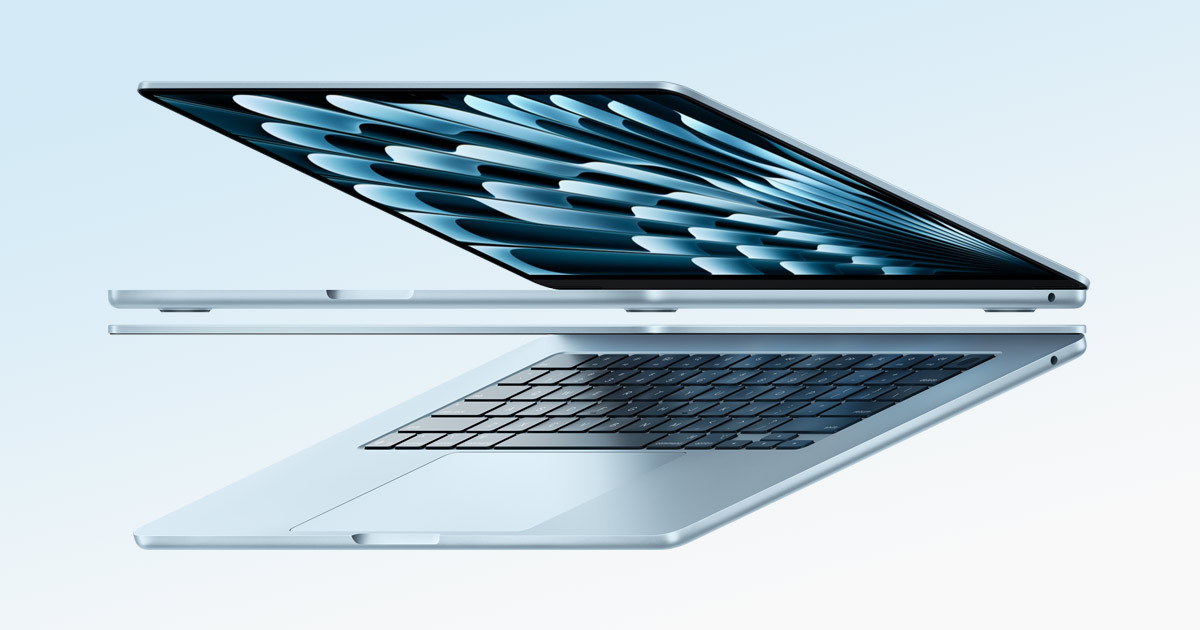
The Apple MacBook Air has evolved into a mature platform that balances power, portability, and value in ways few competitors can match. With the introduction of the M4 chip, Apple has maintained the fanless design while boosting CPU performance by over 20% compared to the M3 generation, all while reducing the entry price. The 13.6-inch and 15.3-inch models feature Liquid Retina displays, improved 12MP Center Stage cameras, and support for dual external monitors - a significant upgrade for productivity users. The MacBook Air continues to deliver 15 to 18 hours of real-world battery life in a chassis weighing just 1.24kg for the 13-inch model, making it one of the most portable full-featured laptops available. Whether used for everyday productivity, creative work, or light gaming, the MacBook Air strikes a compelling balance that has earned widespread praise from both professional reviewers and long-term owners.[1][2][3][4][5][6][7]
Pros
- Exceptional CPU and GPU performance from the M4 chip with fanless operation maintaining quiet, cool operation during typical workloads
- Outstanding battery life consistently delivering 15-18 hours of mixed use, lasting multiple workdays on a single charge
- Premium build quality with robust aluminum unibody construction, excellent keyboard and trackpad, and refined industrial design
- Versatile dual external display support with up to 6K resolution at 60Hz while maintaining portability
- Strong long-term reliability and longevity with users reporting 5+ years of consistent performance without degradation
Cons
- Performance throttling under sustained heavy workloads like video export or code compilation due to fanless thermal design
- Limited port selection with only two Thunderbolt 4 USB-C ports restricting connectivity without adapters
- Base 256GB SSD exhibits slower performance compared to higher capacity configurations
- Fingerprint-prone exterior finishes, particularly on Midnight color option, showing smudges with regular use
- Entry-level 8-core GPU configuration sacrifices graphics performance compared to 10-core option available at higher price
The Apple MacBook Air has evolved into a mature platform that balances power, portability, and value in ways few competitors can match. With the introduction of the M4 chip, Apple has maintained the fanless design while boosting CPU performance by over 20% compared to the M3 generation, all while reducing the entry price. The 13.6-inch and 15.3-inch models feature Liquid Retina displays, improved 12MP Center Stage cameras, and support for dual external monitors - a significant upgrade for productivity users. The MacBook Air continues to deliver 15 to 18 hours of real-world battery life in a chassis weighing just 1.24kg for the 13-inch model, making it one of the most portable full-featured laptops available. Whether used for everyday productivity, creative work, or light gaming, the MacBook Air strikes a compelling balance that has earned widespread praise from both professional reviewers and long-term owners.[1][2][3][4][5][6][7]
Design and Build Quality
The MacBook Air maintains the refined unibody aluminum design introduced in 2022, featuring squared-off edges, a uniformly thin profile, and a premium feel that rivals more expensive ultraportables. The 13.6-inch model weighs just 1.24kg while the 15.3-inch variant reaches 1.51kg, making both genuinely portable for extended carrying. Apple's attention to detail extends to the hinge mechanism, which allows reliable one-handed opening - a seemingly minor feature that consistently impresses users. The keyboard represents one of the strongest elements, with well-spaced keys offering satisfying travel and minimal flex even during aggressive typing. The haptic trackpad remains the benchmark for precision and responsiveness, utilizing Force Touch technology that provides tactile feedback without mechanical movement.[4][20][1][9][6]
Material choices reinforce the premium positioning, with the aluminum chassis resisting flex and demonstrating durability that supports multi-year ownership. However, the exterior finishes, particularly the Midnight color option, show fingerprints and smudges readily, requiring regular cleaning to maintain appearance. The four available colors - Sky Blue, Silver, Starlight, and Midnight - provide personalization options, though the new Sky Blue proves more muted in person than promotional materials suggest.[10][4][12][1]
Performance in Real Use
The M4 chip delivers meaningful performance improvements over the M3 generation, achieving over 20% gains in both single-core and multi-core Geekbench scores. In everyday scenarios involving web browsing, email management, document editing, and video conferencing, the MacBook Air exhibits instantaneous responsiveness without perceptible lag. The 10-core CPU configuration splits workload across four performance cores and six efficiency cores, intelligently allocating tasks to optimize battery life while maintaining snappy operation.[19][3][4][7][1][6]
Creative applications including Adobe Photoshop, Lightroom Classic, and Pixelmator run smoothly during typical editing sessions, though the fanless design introduces thermal constraints during extended intensive work. Video editing in Final Cut Pro or Adobe Premiere remains viable for 1080p and 4K content, but export times lengthen as thermal throttling engages to prevent overheating. Gaming performance proves adequate for less demanding titles and mobile games, though AAA titles require reduced graphics settings and acceptance of the thermal management system limiting sustained frame rates.[14][2][6][8]
The base 256GB SSD configuration exhibits slower read/write speeds compared to higher capacity options due to using a single NAND chip rather than multiple chips in parallel. Users planning substantial local storage should consider upgrading to 512GB or larger capacities to avoid this performance penalty.[2][8]
Ease of Use
macOS Sequoia provides an intuitive foundation that minimizes learning curve even for users transitioning from Windows environments. The operating system integrates seamlessly with iPhone and iPad devices, enabling features like Universal Control, AirDrop, and Handoff that create cohesive workflows across Apple's ecosystem. Apple Intelligence features, powered by the 16-core Neural Engine, add contextual capabilities including improved Siri functionality, intelligent text suggestions, and on-device machine learning processing.[3][4][1][14][6]
The 12MP Center Stage camera represents a notable upgrade from previous generations, delivering improved image quality in video calls and introducing Desk View functionality that simultaneously shows the user's face and overhead workspace perspective. The four-speaker system in the 13-inch model and six-speaker configuration in the 15-inch variant produce clear audio with surprising bass response, adequate for video content and casual music listening without external speakers.[5][21][4][6]
Port selection remains a contentious point, with two Thunderbolt 4 USB-C ports limiting simultaneous connections and necessitating hub purchases for users requiring multiple peripherals. The inclusion of MagSafe 3 charging partially mitigates this limitation by freeing one USB-C port during charging, though the fundamental constraint persists. The 3.5mm headphone jack continues to provide analog audio output, a feature increasingly rare in ultraportable designs.[4][9][8]
Reliability
Long-term ownership experiences consistently report robust reliability extending beyond five years of daily use. Users transitioning from M1 models note sustained performance without degradation after four to five years, suggesting the M4 generation will maintain viability through similar timeframes. The solid-state architecture with no moving parts except the keyboard and trackpad reduces mechanical failure points, while the fanless design eliminates dust accumulation and bearing wear associated with active cooling.[22][10][11][8]
Battery health remains strong even after years of charge cycles, with users reporting minimal capacity loss when following standard charging practices. The unified memory architecture proves durable and reliable, avoiding the instability sometimes associated with traditional RAM modules. Apple's software support typically spans seven years of macOS updates, ensuring security patches and feature additions throughout the device's useful life.[18][10][11]
Durability testing by users reveals resistance to minor impacts, with reports of devices surviving counter-height drops without screen cracks or chassis deformation. The aluminum construction distributes impact forces effectively, though AppleCare coverage remains advisable for users concerned about accidental damage.[9]
Use Cases
The MacBook Air serves effectively across diverse scenarios, from university students managing coursework and research to professionals handling business productivity applications. Content creators working with photography find sufficient performance for image culling, color correction, and batch processing, though professional video editors requiring sustained rendering may exceed thermal capabilities. Software developers utilize the MacBook Air for coding, testing, and light compilation, though large codebases with frequent builds benefit from the active cooling in MacBook Pro models.[12][1][11][8][2][13]
Remote workers appreciate the combination of portability, battery longevity, and video conferencing capabilities that support full workdays away from desk setups. The dual external display support introduced with the M4 generation enhances productivity for users requiring expansive screen real estate when docked, though this capability requires closing the laptop lid. Travelers value the lightweight construction and extended battery life that eliminates constant power outlet searches during flights and hotel stays.[5][3][4][13][9]
Casual gaming remains viable for titles including Civilization VI, Stardew Valley, and Apple Arcade offerings, while cloud gaming services like GeForce Now expand gaming options without demanding local processing. The fanless operation maintains silent performance regardless of workload, making the MacBook Air suitable for quiet environments including libraries, coffee shops, and shared workspaces.[7][14][8][2]
Long-term Ownership Feedback
Multi-year owners consistently highlight the MacBook Air's enduring value proposition, with devices purchased in 2020-2021 continuing to serve daily workflows without performance compromises. The combination of Apple Silicon efficiency and macOS optimization creates a platform that ages gracefully, maintaining responsiveness even as software demands increase. Users report minimal maintenance requirements beyond occasional operating system updates and basic cleaning, avoiding the performance degradation curves associated with some Windows laptops.[22][10][14][11]
Resale values remain strong throughout ownership periods, with MacBook Air models retaining higher percentages of original value compared to Windows alternatives. This residual value reduces total cost of ownership when upgrading to newer generations. The standardized design across model years simplifies accessory compatibility, with cases, sleeves, and adapters remaining functional across multiple generations.[23][20][10][1]
Battery longevity exceeds expectations, with five-year-old devices maintaining adequate capacity for half-day mobile use despite natural degradation. The lack of user-serviceable components poses challenges for battery replacement and storage upgrades, though Apple's service network provides options when necessary. Overall ownership satisfaction remains exceptionally high, with users frequently citing the MacBook Air as the best laptop purchase they have made.[18][10][11][13][9]
| Specification | 13.6-inch MacBook Air M4 | 15.3-inch MacBook Air M4 |
|---|---|---|
| Processor | Apple M4 chip: 10-core CPU (4 performance + 6 efficiency), 8/10-core GPU, 16-core Neural Engine | Apple M4 chip: 10-core CPU (4 performance + 6 efficiency), 10-core GPU, 16-core Neural Engine |
| Memory | 16GB unified memory (configurable to 24GB or 32GB) | 16GB unified memory (configurable to 24GB or 32GB) |
| Storage | 256GB SSD (configurable to 512GB, 1TB, 2TB) | 512GB SSD (configurable to 1TB, 2TB) |
| Display | 13.6-inch Liquid Retina, 2560×1664 resolution, 500 nits brightness, P3 wide color, True Tone | 15.3-inch Liquid Retina, 2880×1864 resolution, 500 nits brightness, P3 wide color, True Tone |
| Battery Life | Up to 18 hours video playback, 15 hours web browsing; 53.8Wh battery | Up to 18 hours video playback, 15 hours web browsing; 66.5Wh battery |
| Camera | 12MP Center Stage with Desk View, 1080p HD video | 12MP Center Stage with Desk View, 1080p HD video |
| Audio | Four-speaker system with Spatial Audio, three-mic array | Six-speaker system with Spatial Audio, three-mic array |
| Ports | MagSafe 3, two Thunderbolt 4 (USB-C), 3.5mm headphone jack | MagSafe 3, two Thunderbolt 4 (USB-C), 3.5mm headphone jack |
| Wireless | Wi-Fi 6E (802.11ax), Bluetooth 5.3 | Wi-Fi 6E (802.11ax), Bluetooth 5.3 |
| Dimensions | 1.13 cm × 30.41 cm × 21.5 cm | 1.15 cm × 34.04 cm × 23.76 cm |
| Weight | 1.24 kg | 1.51 kg |
| Operating System | macOS Sequoia with Apple Intelligence | macOS Sequoia with Apple Intelligence |
| Colors | Sky Blue, Silver, Starlight, Midnight | Sky Blue, Silver, Starlight, Midnight |
Buy
- You need an ultraportable laptop that can handle productivity, creative work, and light gaming without fan noise or excessive heat[7][2]
- Battery life is a priority and you require a device that consistently lasts through full workdays without seeking power outlets[13][3]
- You value long-term reliability and plan to use the same laptop for 5+ years without performance degradation[11][10]
- You work within the Apple ecosystem and benefit from seamless integration with iPhone, iPad, and other Mac devices[6]
- You appreciate refined industrial design, premium build quality, and an intuitive user experience without compromises[1][6]
Skip
- Your workflow involves sustained heavy rendering, 3D modeling, or video encoding that requires active cooling to maintain peak performance[8][6]
- You require extensive port selection and regularly connect multiple peripherals without relying on USB-C hubs or adapters[9][8]
- You need to run specialized Windows-only software or prefer gaming compatibility available on Windows platforms[14][15]
- You're currently using an M2 or M3 MacBook Air and the modest performance gains don't justify an upgrade investment[16][2]
- You require touchscreen functionality for your workflow, which remains absent from the MacBook Air lineup[13]
Critic Reviews
No reviews yet.
User Reviews
No reviews yet.