
Hisense U8QG
This 2025 Mini-LED TV delivers extraordinary brightness, exceptional contrast, and comprehensive gaming features at a compelling mid-range price point, though viewing angles and motion handling reveal its LED limitations.
Updated January 28, 2026
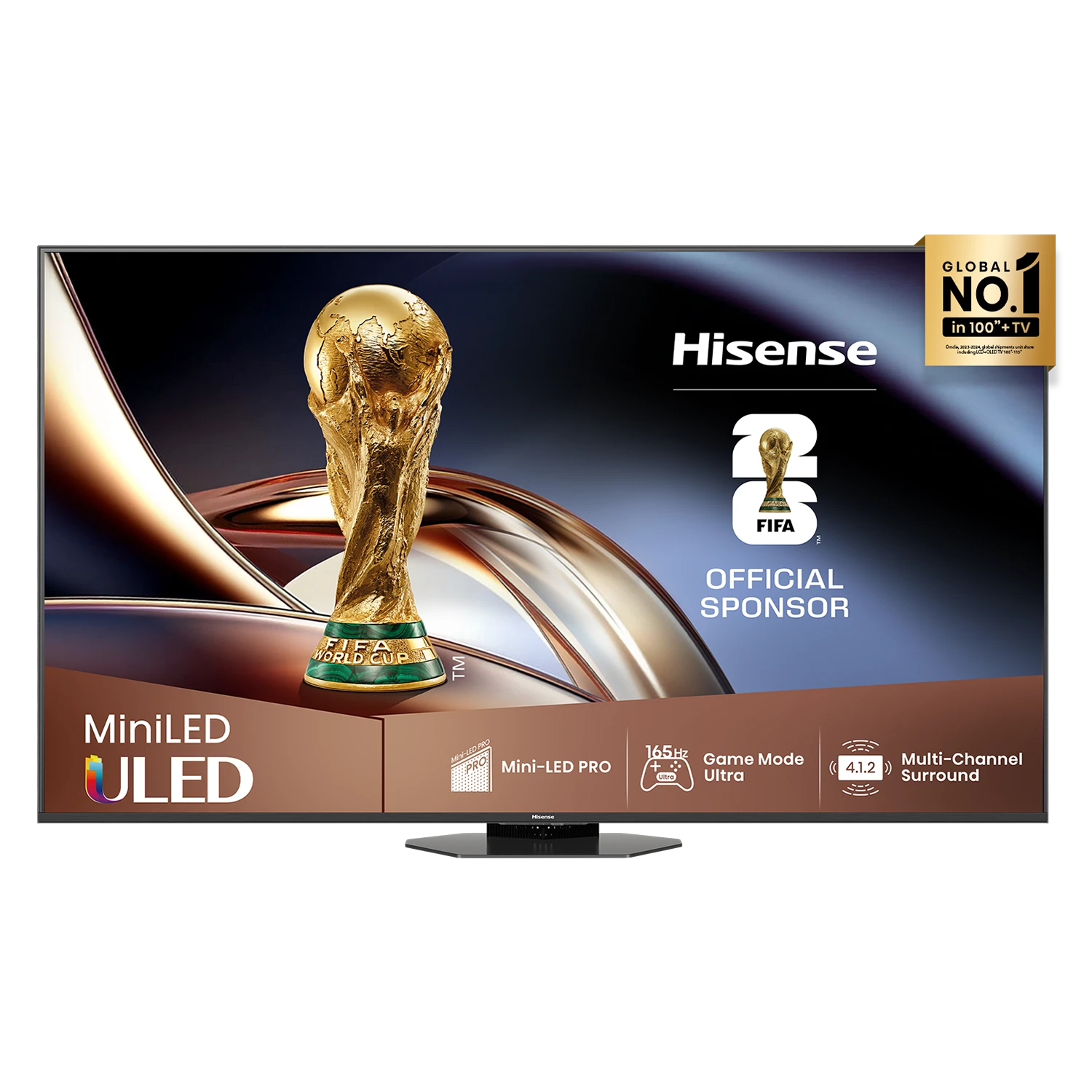
The Hisense U8QG represents a significant leap forward in affordable Mini-LED television technology. As the flagship model in Hisense's 2025 ULED lineup, this TV delivers record-breaking brightness levels exceeding 5,700 nits in some measurements, placing it among the brightest consumer televisions ever tested. The display combines quantum dot color technology with up to 5,376 local dimming zones (depending on size) to produce OLED-rivaling black levels alongside eye-searing HDR highlights. Gaming enthusiasts benefit from a native 165Hz refresh rate, three HDMI 2.1 ports, and an innovative USB-C display port input. While the TV excels in bright rooms and mixed-usage scenarios, it struggles with subpar EOTF tracking that over-brightens HDR content, slow pixel response times that blur fast motion, and viewing angles that degrade image quality from off-center positions. The Google TV interface provides smooth operation with comprehensive app support, though the platform includes unavoidable advertisements. For consumers seeking flagship-level picture quality without premium pricing, the U8QG delivers exceptional value despite specific technical compromises.[1][2][3][4]
Pros
- Exceptional peak brightness: Achieves over 5,700 nits in certain testing conditions, making it one of the brightest consumer TVs available with outstanding performance in bright rooms
- OLED-rivaling contrast: Superb native contrast with mini-LED local dimming produces very deep blacks with minimal blooming around highlights
- Comprehensive gaming features: Native 165Hz refresh rate, 1080p @ 288Hz mode, HDMI 2.1 on all three ports, VRR support, and innovative USB-C display port input
- Wide color gamut coverage: Quantum dot technology delivers approximately 95% DCI-P3 coverage with vibrant, lifelike colors in both SDR and HDR content
- Strong value proposition: Delivers flagship-level brightness and contrast at a mid-range price point that undercuts similarly performing Samsung and Sony models
Cons
- Slow pixel response times: Average response time of 20ms creates noticeable motion blur during fast-moving scenes, particularly problematic for competitive gaming
- Poor EOTF tracking: Significantly over-brightens HDR content beyond creator intent, making most scenes appear much brighter than they should
- Limited viewing angles: VA panel (on 65" and 85" models) exhibits noticeable color washing, gamma shifting, and brightness loss when viewed from off-center positions
- USB-C port limitations: Display port input doesn't support VRR or 1080p @ 288Hz refresh rate, significantly reducing its usefulness for PC gamers
- Disappointing uniformity: Corners appear noticeably dimmer than center, with visible dirty screen effect and slight grid-like patterns during certain content
The Hisense U8QG represents a significant leap forward in affordable Mini-LED television technology. As the flagship model in Hisense's 2025 ULED lineup, this TV delivers record-breaking brightness levels exceeding 5,700 nits in some measurements, placing it among the brightest consumer televisions ever tested. The display combines quantum dot color technology with up to 5,376 local dimming zones (depending on size) to produce OLED-rivaling black levels alongside eye-searing HDR highlights. Gaming enthusiasts benefit from a native 165Hz refresh rate, three HDMI 2.1 ports, and an innovative USB-C display port input. While the TV excels in bright rooms and mixed-usage scenarios, it struggles with subpar EOTF tracking that over-brightens HDR content, slow pixel response times that blur fast motion, and viewing angles that degrade image quality from off-center positions. The Google TV interface provides smooth operation with comprehensive app support, though the platform includes unavoidable advertisements. For consumers seeking flagship-level picture quality without premium pricing, the U8QG delivers exceptional value despite specific technical compromises.[1][2][3][4]
Design and Build Quality
The Hisense U8QG adopts a functional, monitor-like aesthetic that prioritizes performance over sleek minimalism. The display maintains uniform thickness throughout its chassis - approximately 1.75 inches across all panel sizes - which represents a departure from the tapered design of its predecessor. This consistent depth accommodates the substantial mini-LED backlight array and integrated 4.1.2-channel speaker system housed within the frame. The back panel features a grid-patterned plastic construction reminiscent of Sony's premium television designs, lending a more premium appearance than expected at this price point.[11][4][1]
The center-mounted metal stand offers two height positions: a higher configuration that lifts the screen 3.78 inches above the surface to accommodate soundbars, and a lower 2.17-inch option that brings the display closer to the table surface. This stand design requires a modest footprint of approximately 15.75 by 11.42 inches, making it suitable for narrower entertainment furniture. All connectivity ports face sideways but reside in a recessed cutout, which complicates access when wall-mounting the television. The stand incorporates cable management channels to route connections cleanly.[1]
Build quality generally impresses with solid construction and premium materials, though quality control variability appears in some units. RTINGS documented a noticeable backwards bend in their review sample, suggesting inconsistent manufacturing tolerances. While this panel curvature actually improved viewing angle measurements in testing, it represents a cosmetic defect that warrants exchange if encountered. The glossy screen finish contributes to the TV's exceptional reflection handling, significantly reducing the intensity of indirect reflections while maintaining image clarity.[1]
Performance in Real Use
The U8QG's most striking real-world characteristic is its ability to maintain exceptional picture quality across diverse lighting conditions. In bright living rooms with abundant natural light, the television easily overcomes glare while preserving deep black levels and color saturation - a combination that typically requires compromise in competing displays. Peak brightness measurements during standard content viewing exceed 3,300 nits in HDR, with small specular highlights surpassing 4,000 nits in optimal conditions. This translates to HDR content that displays remarkable punch and impact, particularly in scenes mixing bright highlights with dark elements.[8][6][1]
The mini-LED local dimming system with up to 2,048 zones (on the 65-inch model) produces contrast performance that approaches OLED territory in many scenarios. Dark room viewing reveals inky black levels with minimal light bleed, though careful observation exposes subtle blooming around bright objects against pure black backgrounds. This blooming becomes more noticeable when viewing subtitles or white credits on black screens, but remains well-controlled during typical mixed content. The lighting zone transitions handle moving objects competently, though very fast-moving content can produce a dimmer leading edge as zones struggle to keep pace.[4][6][1]
Color reproduction impresses with vibrant, lifelike hues across both SDR and HDR content. The quantum dot technology delivers approximately 95% DCI-P3 color space coverage and 72% Rec. 2020 coverage, ensuring wide gamut content displays with appropriate saturation and separation. Out-of-box color accuracy proves sufficient for most viewers, with Filmmaker Mode and Theater presets delivering reasonable adherence to reference standards without professional calibration. However, critical evaluation reveals oversaturation in reds that can make certain content appear slightly artificial.[3][6][4][1][9]
The television's most significant performance limitation manifests in HDR tone mapping. The display consistently over-brightens HDR content beyond creator intent, making almost all scenes appear substantially brighter than they should. This aggressive tone mapping approach creates immediate visual impact but sacrifices accuracy for home theater purists who prioritize filmmaker intent. Disabling Dynamic Tone Mapping improves tracking but doesn't fully resolve the issue, and the TV lacks granular controls to fine-tune this behavior.[6][1]
Motion handling reveals the inherent compromises of LCD technology. Average pixel response times of 20ms produce noticeable motion blur during fast-moving scenes, particularly problematic for competitive gaming and sports content. Black frame insertion attempts to mitigate persistence blur but only functions at 120Hz and introduces image duplication. The optional motion interpolation system struggles with artifacts and haloing even in moderately fast scenes, limiting its practical usefulness. Response time stutter appears during slow panning shots in cinematic content, though this proves less severe than on OLED displays.[2][1]
Ease of Use
Google TV provides a polished, responsive interface that operates without the frustrating lag that plagues competing platforms. Navigation responds instantly to remote inputs, and the Hi-View AI Engine Pro processor handles multitasking and app switching without noticeable delays. The platform offers comprehensive streaming app support and integrates seamlessly with Google accounts for personalized recommendations and voice control. However, the interface includes unavoidable advertisements that appear in the home screen layout - a common frustration across modern smart TV platforms.[14][3][4][1]
The included remote features backlit buttons and dedicated shortcuts for popular streaming services, simplifying navigation in darkened viewing environments. Voice control through the built-in microphone functions reliably for content searches and basic TV functions. The television supports ATSC 3.0 for over-the-air 4K broadcasts, providing future-proofing for terrestrial television reception.[3][1]
Picture mode selection significantly impacts user experience, and Hisense provides reasonable defaults that minimize setup complexity. Filmmaker Mode delivers the most accurate picture with good color fidelity, while Theater Day and Theater Night modes offer alternative presentations suited to different lighting conditions. Standard mode maximizes brightness but sacrifices some accuracy. Advanced users gain access to comprehensive calibration controls including white balance adjustments, color management systems, and gamma curves.[1][9]
Gaming configuration requires minimal user intervention thanks to automatic low-latency mode that activates when compatible consoles or PCs are detected. The television automatically switches to its optimized Game Mode preset, disabling image processing that increases input lag. A dedicated game bar menu provides quick access to relevant settings including VRR status, frame rate displays, and picture adjustments when using HDMI inputs. Notably, this game bar doesn't appear when using the USB-C display port input, requiring manual navigation to settings menus.[1]
Reliability and Long-Term Ownership
Early adoption experiences reveal generally positive reliability with occasional software quirks requiring attention. Some users report intermittent issues with the TV unexpectedly switching picture modes without user input - a frustrating behavior that appears to affect a subset of units. Reddit discussions suggest these mode-switching incidents may relate to ambient light sensor interactions or specific content triggers, though Hisense hasn't officially acknowledged the issue.[9]
Firmware updates demonstrate Hisense's commitment to ongoing refinement, with multiple updates released during 2025 that improved SDR brightness, HDR brightness, black uniformity, input lag, and EOTF tracking. The October 2025 firmware (V0000.01.00T.P0910) delivered measurable improvements across multiple performance categories, suggesting the manufacturer actively addresses feedback. Consumer reports indicate that recent firmware revisions have resolved earlier EOTF tracking concerns, though professional measurements still show room for improvement.[9][1]
Panel uniformity quality varies between units, with some owners reporting minimal issues while others observe noticeable corner dimming and dirty screen effects. The 65-inch and 85-inch VA panel models appear more susceptible to uniformity concerns compared to the ADS Pro panels used in other sizes. Prospective buyers should verify uniformity during the return window, as this characteristic significantly impacts sports viewing and gaming experiences.[6][1]
The built-in audio system provides adequate performance for casual viewing but lacks the depth and impact necessary for immersive movie experiences. The 4.1.2-channel configuration with 72W output produces clear dialogue at moderate volumes and extends into lower frequencies down to approximately 55Hz before falling off. However, the upward and backward firing design creates diffuse sound that makes dialogue harder to understand at lower volumes. Multiple users recommend pairing the television with a dedicated soundbar or external speaker system for optimal audio quality.[2][6][1][9]
Gaming Performance
The U8QG delivers comprehensive gaming features that address both console and PC gaming requirements. Native 165Hz refresh rate support at 4K resolution provides smooth motion for compatible games, while a specialized 1080p @ 288Hz mode accommodates competitive gamers prioritizing frame rate over resolution. All three HDMI ports support full HDMI 2.1 bandwidth (48Gbps), providing flexibility for connecting multiple high-performance devices simultaneously.[2][1]
Variable refresh rate support proves comprehensive with FreeSync Premium Pro, HDMI Forum VRR, and G-SYNC Compatible certification ensuring tear-free gaming across the TV's entire refresh rate range. Low framerate compensation maintains smooth motion even when frame rates drop substantially below the display's minimum VRR threshold. Unlike its predecessor, the U8QG eliminates response time issues that previously occurred when frame rates hovered around 100Hz, providing consistent performance across the entire refresh rate spectrum.[1]
Input lag measurements reveal excellent responsiveness particularly at higher refresh rates [1][2]. At the native 165Hz maximum, input lag drops to just 4.6ms, providing competitive-level responsiveness for twitch-based gameplay [1]. Even at 60Hz, input lag remains low at approximately 11.6ms, ensuring responsive control across all content types [1]. The television supports Dolby Vision gaming for Xbox Series X|S, enabling enhanced HDR presentation in compatible titles [1].
The innovative USB-C display port input targets PC gamers seeking simplified connectivity, but implementation limitations significantly reduce its practical utility. While the port supports display output up to 4K @ 165Hz with proper 4:4:4 chroma, it inexplicably lacks VRR support and cannot access the 1080p @ 288Hz mode available through HDMI. This renders the USB-C port suitable only for single-cable connectivity in non-gaming scenarios, failing to deliver the seamless PC gaming experience Hisense apparently intended.[2][1]
The TV's most significant gaming limitation stems from slow pixel response times that create motion blur in fast-moving scenes. This proves particularly problematic in competitive multiplayer titles where visual clarity during rapid motion directly impacts player performance. The issue affects both console and PC gaming equally, as it results from fundamental LCD panel characteristics rather than processing limitations. Players focused on single-player experiences or slower-paced games will find the motion blur less intrusive than competitive gamers.[2][9][1]
Use Cases and Target Audience
The U8QG excels as a living room television for households prioritizing bright-room viewing without sacrificing contrast performance. Its ability to maintain deep blacks and vibrant colors in well-lit environments makes it ideal for spaces with large windows or ambient lighting. Families watching mixed content - streaming services, broadcast television, gaming, and movies - benefit from the TV's versatile performance across these scenarios.[6][1]
Sports enthusiasts gain significant advantages from the exceptional brightness and color saturation that reproduces the vibrancy of live events. However, the noticeable dirty screen effect and corner dimming can distract during bright, uniform scenes like ice hockey or basketball courts. The viewing angle limitations make the display less suitable for large gatherings where multiple viewers sit significantly off-axis.[4][1]
Console gamers represent an ideal audience, as the TV fully supports all PS5 and Xbox Series X|S capabilities while delivering excellent input lag and comprehensive VRR support [1]. The exceptional HDR brightness makes gaming experiences particularly impactful, with explosions, fire effects, and bright highlights displaying remarkable intensity [4]. Casual and single-player focused gamers will appreciate the overall experience, though competitive players may find the motion blur limiting [2][9].
Home theater enthusiasts seeking reference-accurate reproduction should look elsewhere, as the aggressive HDR tone mapping fundamentally compromises filmmaker intent. The TV prioritizes immediate visual impact over accurate luminance tracking, making it unsuitable for critical evaluation of cinematography or color grading. Buyers prioritizing accuracy over impact should consider models with superior processing like the Sony BRAVIA 7 QLED.[6][1]
PC gamers face a mixed proposition with notable caveats. The BGR subpixel layout can impact text clarity for productivity use, though not all users find this problematic. The USB-C display port's lack of VRR and 288Hz support significantly limits its appeal for high-refresh gaming, essentially making it useful only for convenience rather than performance. Serious PC gamers should plan on using HDMI 2.1 connections and accepting the slow response times as an inherent limitation.[2][1]
Budget-conscious buyers seeking flagship-level brightness and contrast without premium pricing find exceptional value in the U8QG. The television delivers performance that rivals or exceeds models costing substantially more from established brands like Samsung and Sony. Accepting the specific limitations around motion handling, viewing angles, and EOTF tracking enables access to otherwise premium-tier picture quality.[7][4][9][1]
| Specification | Details |
|---|---|
| Screen Sizes | 55", 65", 75", 85", 100" [1] |
| Panel Type | VA (65", 85", 100") / ADS Pro (55", 75") [1] |
| Resolution | 4K UHD (3840 x 2160) [3] |
| Refresh Rate | 165Hz native, 288Hz at 1080p (QHD mode) [2][1] |
| Dimming Zones | 1,008 (55") / 2,048 (65") / 2,160 (75") / 3,168 (85") / 5,376 (100") [1] |
| Peak Brightness | Up to 5,000 nits advertised (3,000 nits on 55") [3][2] |
| HDR Support | Dolby Vision, Dolby Vision IQ, HDR10+, HDR10+ Adaptive, HLG [1][8] |
| Processor | Hi-View AI Engine Pro (MediaTek Pentonic 800 MT9655) [3][10] |
| Color Gamut | 95% DCI-P3, 81.4% Rec. 2020, Quantum Dot technology [3][6] |
| HDMI Ports | 3x HDMI 2.1 (48Gbps bandwidth) [1][3] |
| Additional Ports | 1x USB-C (Display Port), 2x USB (2.0 and 3.0), Ethernet, Optical Audio, 3.5mm jack [3] |
| Audio System | 4.1.2-channel, 72W output (65" model), Dolby Atmos, DTS Virtual:X [11][1] |
| Smart Platform | Google TV with Wi-Fi 6 and Bluetooth 5.3 [3][1] |
| Tuner | ATSC 3.0 (4K over-the-air support) [1][3] |
| VRR Support | FreeSync Premium Pro, HDMI Forum VRR, G-SYNC Compatible [1] |
Buy
- Bright room viewing: Outstanding SDR brightness easily overcomes glare from windows and ambient lighting while maintaining deep blacks and color saturation[6][1]
- HDR content impact: Exceptional HDR brightness makes specular highlights and bright scenes truly pop with remarkable visual impact[8][1]
- Console gaming: Full compatibility with PS5 and Xbox Series X|S features including 4k @ 120Hz, Dolby Vision gaming, and auto low-latency mode [1]
- Large screen availability: Available in sizes up to 100 inches with consistent performance characteristics across the 65" and 85" VA panel models[3](https://www.displayspecifications.com/en ews/8115de8)[1]
- Out-of-box accuracy: Filmmaker Mode and Theater presets deliver good color accuracy without professional calibration for most users[9][1]
Skip
- Home theater purists: Subpar EOTF tracking over-brightens HDR content, failing to maintain filmmaker intent in reference viewing conditions[1][6]
- Wide seating arrangements: Okay viewing angle performance makes this unsuitable for rooms with viewers sitting significantly off-axis[4][1]
- Competitive gaming priority: Slow pixel transitions create motion blur that impacts clarity in fast-paced competitive titles[2][1]
- OLED-level motion: Response time stutter appears during slow panning shots in movies due to quick response time combined with sample-and-hold[1]
- Superior local dimming needs: TCL QM8K offers better black uniformity and more precise blooming control for dark room viewing[1]
Critic Reviews
No reviews yet.
User Reviews
No reviews yet.