
LG C4 OLED
LG's 2024 mid-range OLED elevates picture quality and gaming capabilities with 144Hz support, enhanced brightness, and perfect blacks, though some limitations in Game Mode and average audio hold it back from perfection.
Updated January 28, 2026
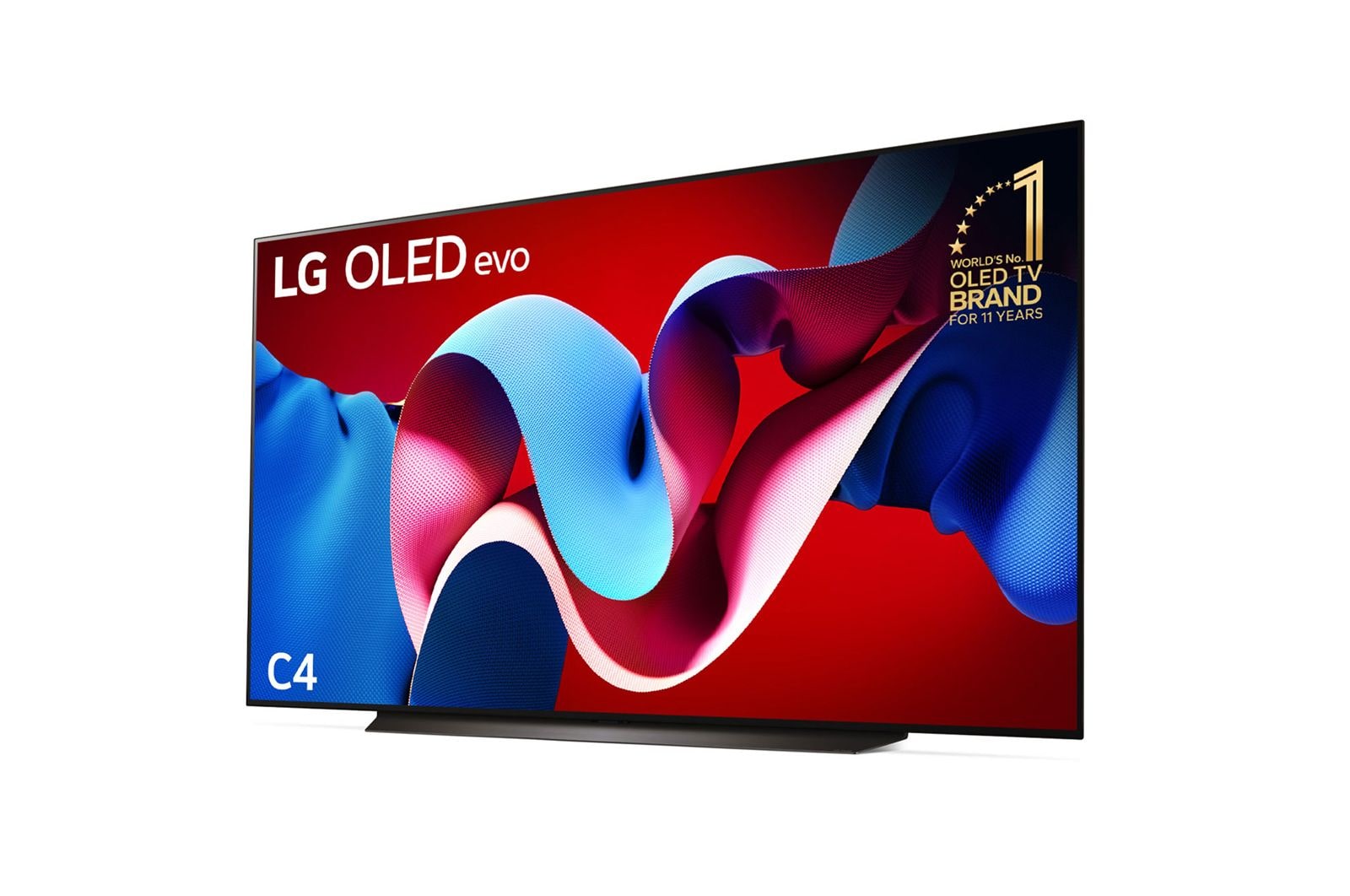
The LG C4 OLED represents a meaningful evolution in LG's popular C-Series lineup, offering improved brightness over its predecessor while maintaining the perfect blacks and vibrant colors that make OLED technology compelling. Powered by the α9 Gen7 AI Processor, this 2024 model introduces 144Hz support for PC gaming and delivers excellent performance across movies, sports, and console gaming. The C4 handles HDR content with authority, reaching over 1,000 nits peak brightness in testing, creating an impactful viewing experience especially when highlights contrast against inky black levels. Four HDMI 2.1 ports ensure compatibility with current and future gaming hardware, while webOS 24 provides a streamlined smart TV experience with improved user profiles and organization. Direct reflections remain a concern in bright rooms, and the TV loses significant brightness when switched to Game Optimizer mode. Audio performance is merely adequate, suggesting most users will benefit from an external soundbar. Despite these limitations, the C4 delivers exceptional picture quality, gaming features, and overall value that cement its position as one of the most capable mid-range OLEDs available.[1][2][3][4][5]
Pros
- Perfect black levels with near-infinite contrast ratio create stunning image depth without any blooming around bright highlights
- Native 144Hz refresh rate support on all four HDMI 2.1 ports enables advanced PC gaming capabilities alongside excellent console support
- Vibrant, accurate colors with excellent pre-calibration accuracy and impressive coverage of DCI-P3 color space
- Incredibly wide viewing angle maintains consistent image quality from side positions, ideal for group viewing
- Exceptionally low input lag of 9.2ms in Boost mode delivers responsive gaming experience with minimal delay
Cons
- HDR brightness drops noticeably when using Game Optimizer mode, diminishing highlight impact during gaming sessions
- Direct reflections from lamps and windows are distracting due to mediocre reflection handling despite adequate SDR brightness
- Audio system delivers only adequate performance with limited bass and compression artifacts at higher volumes
- Low frame rate content exhibits noticeable stutter due to near-instantaneous pixel response time during slow panning shots
- Smaller 42-inch and 48-inch models lack Brightness Booster technology and appear dimmer than larger sizes
The LG C4 OLED represents a meaningful evolution in LG's popular C-Series lineup, offering improved brightness over its predecessor while maintaining the perfect blacks and vibrant colors that make OLED technology compelling. Powered by the α9 Gen7 AI Processor, this 2024 model introduces 144Hz support for PC gaming and delivers excellent performance across movies, sports, and console gaming. The C4 handles HDR content with authority, reaching over 1,000 nits peak brightness in testing, creating an impactful viewing experience especially when highlights contrast against inky black levels. Four HDMI 2.1 ports ensure compatibility with current and future gaming hardware, while webOS 24 provides a streamlined smart TV experience with improved user profiles and organization. Direct reflections remain a concern in bright rooms, and the TV loses significant brightness when switched to Game Optimizer mode. Audio performance is merely adequate, suggesting most users will benefit from an external soundbar. Despite these limitations, the C4 delivers exceptional picture quality, gaming features, and overall value that cement its position as one of the most capable mid-range OLEDs available.[1][2][3][4][5]
Design and Build Quality
The LG C4 OLED exemplifies premium television design with an ultrathin profile measuring just 1.8 inches at its deepest point and barely a quarter-inch at its narrowest. The 65-inch model weighs 36.6 pounds without its stand, featuring a sleek metal lining along the edge that creates an elegant, futuristic appearance. The rear panel showcases a unique stone-like textured finish that distinguishes it from competitors and provides a grainy tactile quality. Build quality feels sturdy despite the thin profile, though the substantial size requires two people for safe installation and setup.[3][2][1]
The included aluminum pedestal stand offers both aesthetic appeal and functional design. Its central positioning provides stable support with minimal wobble, while elevating the screen approximately 2.7 inches above the table surface to accommodate most soundbars without blocking the display. The brushed metal foot matches the screen's premium aesthetic, and cable management clips on both the back panel and stand help maintain a clean appearance. Four VESA mounting holes (300x200mm pattern) enable wall mounting for those preferring that installation method. The permanently attached power cable routes cleanly through the stand with a snap-on panel concealing the connection point.[2][1]
Port placement demonstrates thoughtful engineering, with all connections positioned on the left edge of the control box on the TV's rear. This location provides easy access when the TV sits on its stand, though wall mounting makes ports harder to reach. All four HDMI ports support full HDMI 2.1 bandwidth at 48Gbps, a future-proofing decision that many manufacturers skip even on flagship models. Additional connectivity includes three USB ports, Ethernet, optical audio output, coaxial cable input, and RS-232C service port. Minimal bezels around the display remain nearly invisible during viewing, maximizing screen real estate and creating an immersive experience.[2][1]
Picture Quality and Performance
The C4's picture performance represents a meaningful step forward from its predecessor, delivering the perfect blacks and infinite contrast ratio that define OLED technology. Black levels appear deep and inky in dark room viewing, with absolutely no blooming around bright highlights regardless of content. This fundamental OLED advantage creates stunning image depth that LCD technologies with local dimming cannot match. Colors emerge vibrant, lifelike, and accurate across both SDR and HDR content, with excellent pre-calibration accuracy that respects creator intent without requiring professional adjustment.[1]
Brightness improvements mark the C4's most significant upgrade over the C3, with measurements reaching 1,049 nits peak brightness in HDR and 296 nits in SDR when tested in a 10% window. This represents substantial gains over the C3's 820 and 237 nits respectively, though Samsung's S95C QD-OLED still leads with 1,369 nits. The 55-inch and larger models include LG's Brightness Booster technology that enables these higher light output levels, while the 42-inch and 48-inch versions lack this feature and appear noticeably dimmer. HDR content benefits significantly from this increased brightness capability, with highlights popping effectively against the perfect black levels to create an impactful viewing experience.[4][2][1]
Color performance proves impressive across multiple metrics, with outstanding coverage of the DCI-P3 color space at 98.15% and solid Rec. 2020 coverage at 72.27%. The TV's Delta-E measurement of 1.8201 indicates excellent color accuracy, though competitors like the Samsung S95C achieve slightly better numbers. Color volume remains very good, with the WOLED panel's white subpixel helping display bright whites excellently while the TV struggles slightly more with very light colors. The α9 Gen7 AI Processor delivers excellent HDR brightness accuracy and smooth color gradients with minimal banding. Image processing capabilities impress across applications, with very good upscaling of low-resolution content keeping DVDs and compressed streams looking sharp.[2][1]
Viewing angle performance stands out as exceptional, maintaining consistent image quality even from extreme side positions. This characteristic makes the C4 ideal for wide seating arrangements or group viewing scenarios where multiple viewers sit off-axis. Screen uniformity measures as excellent, with minimal dirty screen effect in the center that benefits sports viewing. The WOLED panel uses an RWBG subpixel structure where all four pixels never illuminate simultaneously, which can create minor text rendering issues on Windows systems due to ClearType optimization for RGB layouts. Most users won't notice this concern, though PC users should be aware of the potential.[1]
Gaming Performance
Gaming capabilities represent a key strength of the C4, with comprehensive modern feature support that appeals to both console and PC gamers. All four HDMI 2.1 ports support 4K at 120Hz with variable refresh rate, while the TV achieves certification as the first 144Hz-capable display for PC gaming when connected to compatible hardware. Input lag measures an already-low 12.9ms in standard Game Mode, but activating the Boost feature in Game Optimizer drops this to an exceptional 9.2ms. This responsiveness creates a tight connection between controller inputs and on-screen action that competitive gamers will appreciate.[5][2][1]
VRR support proves comprehensive, with compatibility for HDMI Forum VRR, AMD FreeSync Premium, and Nvidia G-Sync. This ensures tear-free gaming experiences across Xbox, PlayStation 5, and PC platforms. Auto Low Latency Mode automatically switches to Game Optimizer when the TV detects gaming signals, eliminating the need for manual picture mode changes. The nearly instantaneous pixel response time creates exceptionally clear motion with no noticeable blur behind fast-moving objects, a significant advantage for fast-paced gaming.[5][1]
However, a notable limitation emerges in Game Optimizer mode, where HDR brightness drops significantly compared to other picture modes. While the TV remains bright enough to provide an impactful gaming experience, the reduced light output becomes noticeable when switching between gaming and movie content. The perfect black levels and vibrant colors help compensate for this brightness reduction, but gamers prioritizing maximum HDR impact during gameplay may prefer alternatives that maintain brightness across all modes. The C4 also supports Dolby Vision gaming, a relatively rare feature that enhances compatible titles on Xbox platforms.[2][1]
The Game Dashboard provides convenient access to gaming-specific settings without leaving the game. Activating it displays current frame rate, VRR status, black stabilizer level, and Low Latency activation status, while providing quick access to Dark Room Mode, Multi View, Game Optimizer settings, and overall TV settings. Cloud gaming through GeForce Now and other services integrates directly into the TV, eliminating the need for external hardware for supported titles. This comprehensive gaming feature set positions the C4 as one of the most capable gaming displays available in its price range.[5][2]
Smart Features and Usability
WebOS 24 delivers a refined smart TV experience that balances functionality with visual appeal. The interface features a streamlined design with improved organization compared to previous versions, now supporting up to 10 user profiles for household customization. The home screen opens with a large rotating advertisement carousel at the top, followed by a row of Quick Cards that organize TV features into six categories: Home Office, Games, Music, Home Hub (for ThinQ smart home integration), Sports (with team following and statistics), and Accessibility. Users can remove top banner ads and suggested content through the 'Home Promotion' and 'Content Recommendation' settings in the Home Settings menu, creating a cleaner interface, though ads in the apps page cannot be eliminated.[5][2][1]
App organization proves intuitive, with a customizable row prepopulated with popular streaming services that users can add to, subtract from, or reorder according to preference. The interface responds quickly to inputs without lag or stuttering, contributing to a smooth user experience. LG promises at least four years of webOS updates for the C4, with webOS 25 expected to arrive toward the end of 2025. Casting support expands significantly with the addition of Chromecast alongside existing Apple AirPlay 2 compatibility, enabling easy content sharing from mobile devices.[2][1]
The Magic Remote continues to impress with its ergonomic design and dual control modes. Users can operate it as a traditional remote using the five-way directional pad with integrated scroll wheel, or wave it to activate an on-screen pointer for mouse-like navigation. The remote's comfortable size and classic shape stand out against the trend toward smaller, more rectangular designs, though some users find the pointer jittery. Button layout proves logical, with power and number pad at the top and six streaming service shortcuts (Netflix, Prime Video, Disney+, LG Channels, Sling, and Alexa) along the bottom.[2][1]
Voice control functionality works through built-in microphones on the TV itself, enabling hands-free operation. Users can change inputs, open apps, search for content, and request information like weather and time without touching the remote. However, the 2024 models include only an ATSC 1.0 tuner due to patent disputes, eliminating the ATSC 3.0 tuner found in previous years' LG TVs. This represents a step backward that prevents over-the-air 4K broadcast reception, a concern for viewers relying on antenna television.[1][2]
Audio Quality
Audio performance emerges as the C4's weakest attribute, delivering merely adequate sound quality that doesn't match the visual experience. The 40W 2.2-channel speaker system (on 55-inch and larger models) includes virtual 9.1.2 up-mixing through the α9 AI Sound Pro feature, with Dolby Atmos support providing some spatial audio capability. However, the downward-firing speakers produce limited bass response and lack the impact needed for immersive content. Dialog clarity remains acceptable with a reasonably balanced sound profile, but the system doesn't achieve high volume levels and exhibits compression and pumping artifacts when pushed to maximum.[2][1]
Testing with bass-heavy tracks and vocal-focused content reveals the system's limitations compared to higher-end competitors using innovative speaker technologies. The TV's thin profile necessarily constrains speaker size and placement, contributing to the underwhelming audio performance. For casual viewing of news, sitcoms, and general programming, the built-in speakers suffice. However, anyone seeking an immersive experience with movies, dramatic television, or gaming will want to invest in an external soundbar or audio system. This additional expense should factor into purchasing decisions, particularly given the TV's already-premium pricing.[2]
Real-World Use Cases
Home theater applications represent the C4's ideal use case, where controlled lighting conditions allow the OLED panel to shine. The perfect black levels create stunning depth in dark scenes, while the improved brightness handles highlights effectively in HDR content ranging from the vibrant animation of The Super Mario Bros. Movie to the contrasting black-and-white sequences in Oppenheimer
The 120Hz panel keeps action sequences smooth in films like *Mission
Impossible - Dead Reckoning*, while the wide viewing angle ensures every seat in the room gets a quality picture. Sports viewing benefits from excellent screen uniformity, fast response time for clear motion, and accurate colors that render team jerseys correctly.[1][2]
Bright room performance proves adequate but not exceptional, with SDR brightness sufficient to overcome moderate glare but struggling with direct reflections from windows or lamps positioned opposite the screen. Users report reasonable performance even in rooms filled with natural sunlight, though the viewing experience improves dramatically in darker conditions. The TV handles ambient lighting better than many OLEDs, maintaining deep blacks and well-saturated colors even with room lights on. However, direct light sources create distracting reflections that diminish the viewing experience more than on competing models with better reflection handling.[8][1]
Long-term ownership feedback from early adopters indicates high satisfaction levels, with users noting the viewing experience surpasses previous television technologies. The ultrathin profile and minimal bezels create a modern aesthetic that complements contemporary living spaces. Setup and configuration prove straightforward, though some users find the Magic Remote's pointer navigation takes adjustment. The webOS interface receives praise for ease of use, while the comprehensive gaming features appeal to households with multiple console or PC gamers. The TV's wide size availability (42 to 83 inches) enables finding an appropriate screen size for various room dimensions and viewing distances.[8][9][5][1][2]
| Specification | Details |
|---|---|
| Display Technology | WOLED (White OLED) with RWBG subpixel structure [1] |
| Available Sizes | 42", 48", 55", 65", 77", 83" [1][2] |
| Processor | α9 Gen7 AI Processor 4K [1][2] |
| Refresh Rate | 120Hz native, 144Hz certified for PC gaming [1][5] |
| Resolution | 3840 x 2160 (4K UHD) [3] |
| HDR Support | HDR10, HLG, Dolby Vision [3][2] |
| HDMI Ports | 4x HDMI 2.1 (48Gbps bandwidth) [1][2] |
| VRR Support | HDMI Forum VRR, FreeSync Premium, G-Sync Compatible [5][1] |
| Smart Platform | webOS 24 [3][2] |
| Audio System | 40W 2.2 channel (55" and larger), 20W 2.0 (42") [1][2] |
| Connectivity | 3 USB ports, Ethernet, optical audio, coaxial, RS-232C [3][2] |
| Voice Control | Built-in microphones for hands-free Alexa control [1] |
Buy
- Home theater enthusiasts seeking perfect black levels and vibrant HDR performance in darker viewing environments will appreciate the OLED panel's capabilities[6][1]
- Gamers requiring comprehensive modern features including 4K 144Hz, VRR, G-Sync compatibility, and FreeSync Premium will find exceptional support[5][2]
- Users with wide seating arrangements benefit from the incredibly wide viewing angle that maintains image quality from side positions[1]
- Those upgrading from older TVs will notice significant improvements in brightness, sharpness, and overall picture dynamism compared to previous generations[6]
- Buyers wanting future-proof connectivity appreciate all four HDMI ports supporting full HDMI 2.1 bandwidth and advanced features[5][2]
Skip
- Competitive gamers prioritizing maximum HDR brightness during gameplay should consider alternatives that maintain brightness in game modes[1]
- Rooms with significant direct lighting from windows or lamps will experience distracting reflections that compromise the viewing experience[1]
- Audiophiles or users without external audio systems will find the built-in 40W speakers underwhelming for immersive content[2]
- Budget-conscious buyers may find better value in last year's C3 or competing models that have dropped significantly in price[2]
- Over-the-air broadcast enthusiasts need ATSC 3.0 tuner support that LG removed from 2024 models due to patent disputes[2]
Critic Reviews
No reviews yet.
User Reviews
No reviews yet.