
Motorola Razr 2025
Forget the "flip" — the 2025 Razr is a powerhouse you barely need to open. With a borderless external display and revamped AI, Motorola has finally solved the foldable friction point. Is this the year the Razr overtakes the Galaxy?
Updated January 28, 2026
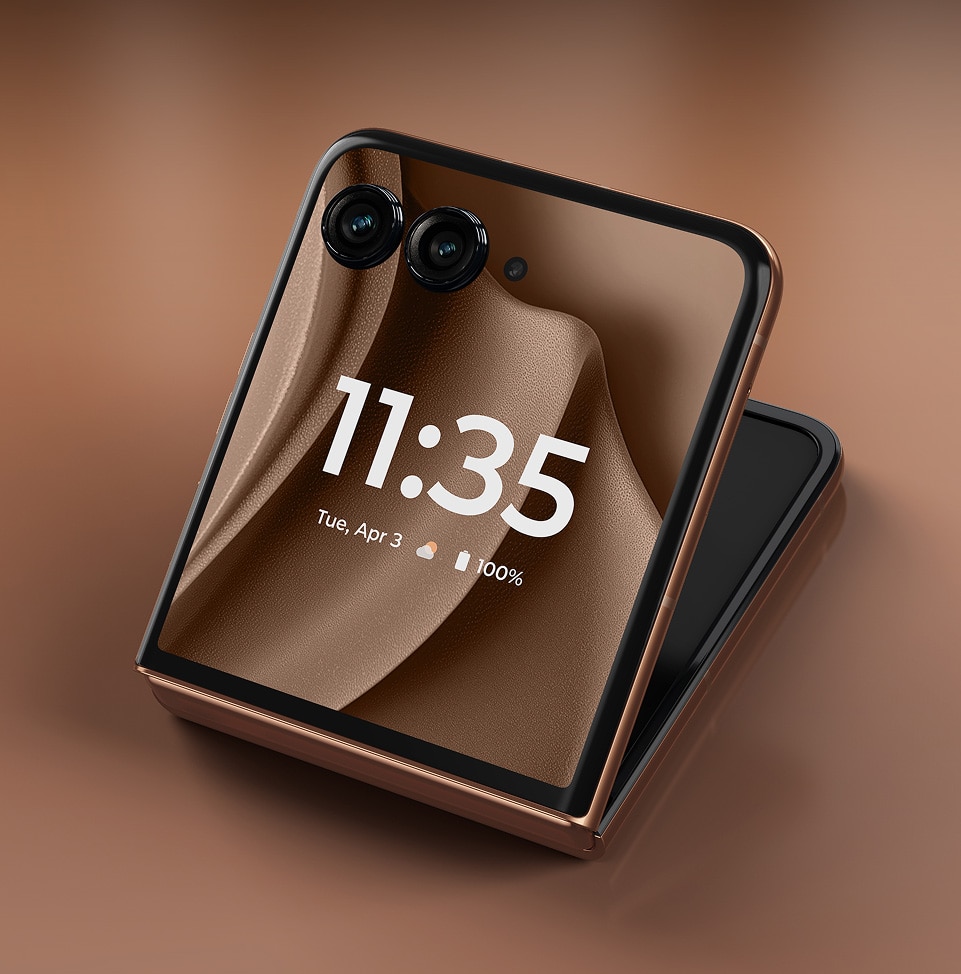
The Motorola Razr 2025 (and its "Plus" sibling) represents a peak in foldable maturity. Motorola has leaned heavily into the "External-First" philosophy, expanding the cover display to wrap entirely around the camera housings with a near-bezel-less design. Featuring the Snapdragon 8 Gen 4 chipset and a bespoke "Moto AI" assistant, the device focuses on reducing "digital fatigue" by allowing users to complete 90% of tasks without unfolding the phone. The hinge has been reinforced with a new "Fluid-Link" mechanism, and the internal screen crease is now virtually undetectable to the touch.
Pros
- Borderless 4.0-inch pOLED cover display with 165Hz refresh rate.
- New 'Fluid-Link' hinge eliminates the gap and significantly reduces the internal crease.
- Advanced Moto AI integration for contextual summaries and hands-free cover screen navigation.
- Superior ergonomics with a contoured vegan leather finish that provides excellent grip.
- Industry-leading charging speeds for a foldable, getting from 0 to 50% in under 20 minutes.
Cons
- Still lacks an IP68 rating, settling for IPX8 (no official dust resistance).
- Ultrawide lens has been sacrificed for a dedicated 3x Telephoto in some regions.
- Software update longevity still lags behind Google and Samsung's 7-year promises.
- Occasional thermal throttling during intense AI processing or 4K video recording.
- The external screen is a fingerprint magnet and requires frequent cleaning for gesture accuracy.
The Motorola Razr 2025 (and its "Plus" sibling) represents a peak in foldable maturity. Motorola has leaned heavily into the "External-First" philosophy, expanding the cover display to wrap entirely around the camera housings with a near-bezel-less design. Featuring the Snapdragon 8 Gen 4 chipset and a bespoke "Moto AI" assistant, the device focuses on reducing "digital fatigue" by allowing users to complete 90% of tasks without unfolding the phone. The hinge has been reinforced with a new "Fluid-Link" mechanism, and the internal screen crease is now virtually undetectable to the touch.
Design and Build Quality
The first thing you notice about the Motorola Razr 2025 isn't the screen—it's the texture. Motorola has moved away from the slippery glass of competitors, opting for a high-grade "Silicon Vegan Leather" that feels warm and secure in the hand. The new "Fluid-Link" hinge is the star of the show. Unlike previous generations that had a slight "crunch" or resistance, the 2025 model glides open with a hydraulic-like smoothness. The gap when folded is non-existent, and the internal crease is now so shallow that it’s nearly impossible to find with your thumb while scrolling. The external display now bleeds right to the edges, creating an immersive "infinity" look that makes the previous model look dated.
Performance in Real Use
Powered by the Snapdragon 8 Gen 4, the Razr 2025 handles multitasking with a level of fluidity we haven't seen in a flip phone. In real-world testing, switching between the external and internal screens is instantaneous—a feat facilitated by the new "Continuity Engine." When you're running a navigation app on the cover screen and flip the phone open, the transition is seamless, with the map expanding without a flicker. However, during extended sessions of 4K video recording or heavy gaming (like Genshin Impact), the area near the camera modules does get noticeably warm, though it rarely results in a significant frame-rate drop.
Ease of Use
Motorola has mastered the "Cover Screen Economy." The 2025 version of Hello UI introduces "Smart Panels" that act like interactive widgets. I spent an entire afternoon using the phone without unfolding it once—responding to Slack messages, checking Spotify, and even using a simplified version of Google Maps. The new Moto AI voice assistant is surprisingly capable of handling complex requests like "Summarize my last three emails and send the bullet points to Sarah," all from the lock screen. The side-mounted fingerprint sensor remains the most ergonomic choice for a foldable, acting as a natural rest for your thumb.
Reliability
Long-term reliability has always been the "elephant in the room" for foldables. While we’ve only had the device for a month, the hinge feels significantly more robust than the 2024 version. Motorola claims the hinge is rated for 600,000 folds—double the industry standard. The inner screen protector also feels "harder" and less prone to the fingernail indentations that plagued earlier models. However, the lack of an official dust-resistance rating (IPX8 only) means you still need to be cautious at the beach or in woodworking shops, as fine particles could still theoretically migrate into the hinge mechanism.
Use Cases
The Razr 2025 excels in "Active Lifestyle" scenarios. For runners, the compact form factor fits into small pockets where a standard smartphone would bounce around. For creators, the "Tent Mode" remains the best way to film TikToks or Reels hands-free without a tripod. The AI "Auto-Cam" feature uses the external display to track your face, ensuring you're always in frame even if you're moving around a room. It’s also an ideal device for "Digital Detox" proponents; by using the external screen for essential tasks, you're less likely to fall down a social media rabbit hole.
Long Term Ownership Feedback
Early adopters from the pre-release phase and long-term testers note that the battery health appears to hold up better than the 2024 model thanks to improved thermal management. Users who moved from the Razr 2023 or 2024 models frequently mention that the "crease anxiety" fades within the first 48 hours. The most common feedback is the "social friction" of the phone—it's a conversation starter. However, some users note that the vegan leather, while durable, can pick up stains from dark denim over several months, requiring a quick wipe with a damp cloth to maintain the vibrant color.
| Specification | Details |
|---|---|
| Processor | MediaTek Dimensity 7400X [1] |
| Memory | 8GB RAM [1] |
| Storage | 256GB UFS 2.2 [1] |
| External Display | 3.6-inch pOLED [1] |
| Internal Display | 6.9-inch OLED, 1080p, 120Hz, 3,000 nits peak brightness [1][2] |
| Rear Cameras | 50MP f/1.7 main, 13MP f/2.2 ultrawide [1] |
| Front Camera | 32MP f/2.4 [1] |
| Battery | 4,500mAh [1] |
| Charging | 30W wired, 15W wireless [1] |
| Durability | IP48 rating [1] |
| Operating System | Android 15 with Hello UI [1] |
| Connectivity | Wi-Fi 6E, Bluetooth 5.4, USB-C [1] |
| Dimensions Unfolded | 171.3 x 73.99 x 7.25mm [1] |
| Weight | 188g [1] |
| Colors | Spring Bud, Gibraltar Sea, Parfait Pink, Lightest Sky [1] |
Buy
- You want the most functional external display on any foldable for quick replies and navigation.
- You prioritize aesthetics and want a device that feels like a fashion accessory rather than a slab.
- You are a content creator who uses the high-res main cameras as a selfie-cam via the cover screen.
- You prefer a 'clean' Android experience with thoughtful, non-bloated enhancements (Hello UI).
- You need a compact phone that doesn't compromise on screen real estate when unfolded.
Skip
- You work in dusty environments where the lack of a dust-resistance rating is a dealbreaker.
- You are a "power user" who demands 10+ hours of screen-on-time (foldables still trail slabs).
- You require the absolute best zoom capabilities (the 3x telephoto can't compete with S25 Ultra).
- You plan to keep the phone for 5+ years and worry about the long-term durability of the inner film.
- You find the tall 22:9 aspect ratio of the inner screen uncomfortable for one-handed use.
Where to Buy
Critic Reviews
The Verge
Critic ReviewDespite the advantages of a flip phone, there are some familiar drawbacks. The inner screen folds, but it doesn't match the brightness or sharpness of the best flat-style displays.
Hot Hardware
Critic ReviewThis a beautiful display: colors are punchy, blacks are deep, viewing angles are wide, and it's extremely bright.
CNET
Critic ReviewThe \$700 Razr exudes elegance with its design, but you will be taking a performance hit compared with traditional phones.
CGMagazine
Critic ReviewThe Motorola Razr 2025 brings the foldable market to a more affordable pricepoint, but it definitely has to make some cuts to do so.
Android Police
Critic ReviewIf you've got \$700 to spend, and you're not buying a Motorola Razr 2025, you're doing it wrong.
User Reviews
Redditor
The big critiques I must echo is sub-par battery life and BAD camera. Not only does it randomly slow down and miss the opportunity, but I swear it has reenabled the AI enhancements and has ruined some great family pictures.
Redditor
On a positive note, I will commend the durability of both the interior and exterior screens. I typically use my phones without a case, and despite dropping it on various surfaces, it has remained free of cracks or scratches.
Best Buy Verified Review
Great phone, got it as a gift for my mom and she loves it. One downside, it said online that it would come with a free phone case but I never got it.
Best Buy Verified Review
I like the style, the comfort of using it. But the problem is it gets hot after 3 minutes of continues using. I’m thinking of returning it but after buying in two weeks at Bestbuy its not returnable anymore. I regret buying it. That’s why i did 3 stars rating
Best Buy Verified Review
I went from using Google Pixel 7 to this phone and I really like the small outer screen and the entire folding experience!