
MSI Crosshair 16 HX
This mid-range gaming laptop delivers exceptional cooling and solid CPU performance, but its GPU struggles to fully utilize the high refresh display at native resolution.
Updated January 28, 2026
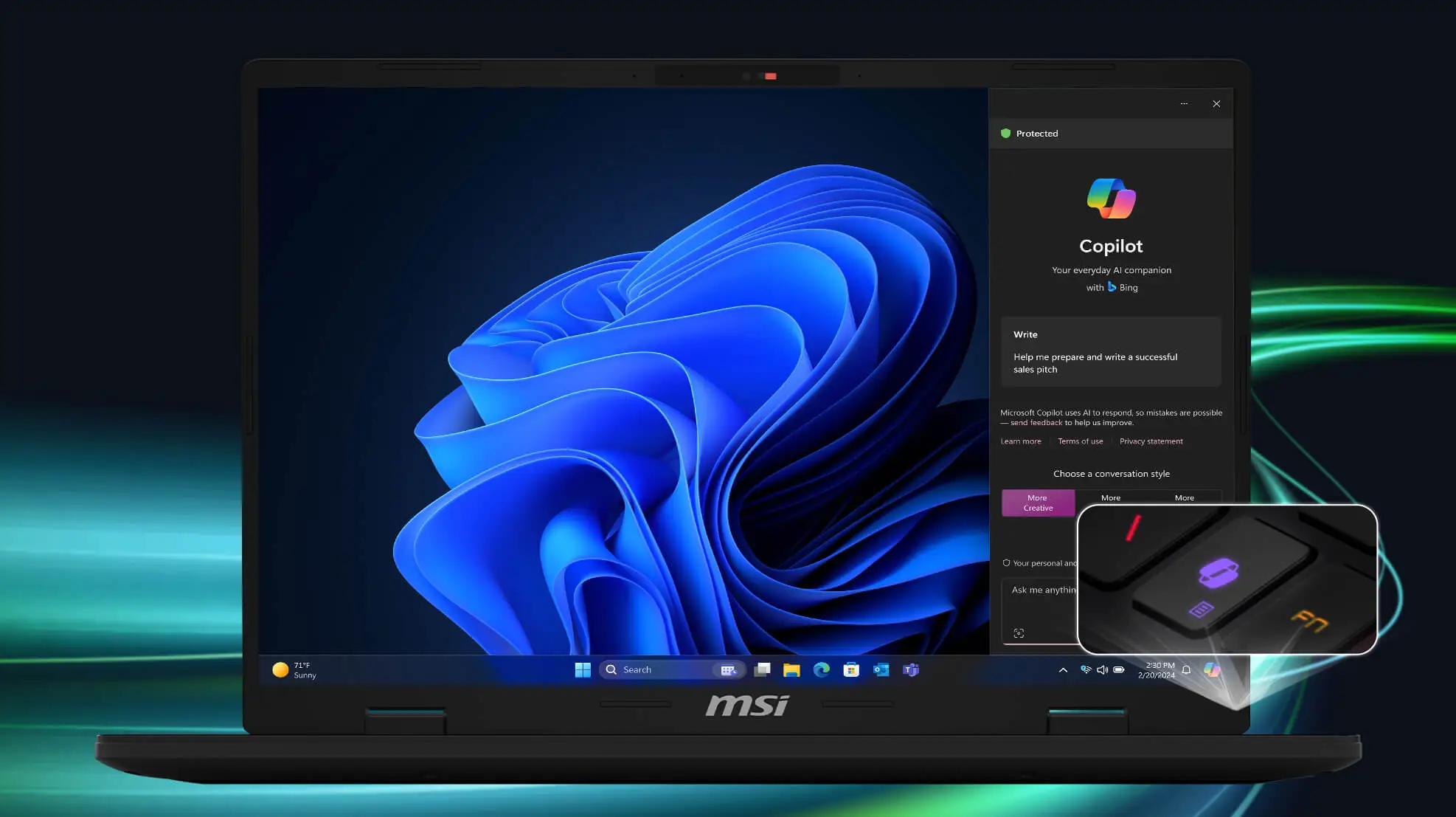
The MSI Crosshair 16 HX positions itself as a versatile gaming laptop that balances portability with performance. Equipped with either Intel Core i7 14700HX or Core Ultra 9 275HX processors paired with RTX 4060 or RTX 5070 GPUs, the Crosshair 16 HX features a 16-inch QHD+ (2560x1600) 240Hz IPS display. The laptop stands out for its exceptional thermal management system, Cooler Boost 5 technology that keeps temperatures remarkably low even under sustained load. While the build quality feels premium and the keyboard offers satisfying tactile feedback, the pairing of a high-refresh display with mid-tier graphics creates a performance mismatch. The device excels at productivity tasks and CPU-intensive workloads but requires settings adjustments to achieve frame rates that match the display capability.[1][2][3]
Pros
- Exceptional thermal performance with Cooler Boost 5 technology keeping GPU temperatures below 70°C under full load
- Strong CPU performance that outperforms some flagship laptops with the same processor
- Satisfying keyboard with good key travel and 24-zone RGB lighting
- Solid build quality that feels sturdy and portable at 2.5kg
- Expandable storage with dual M.2 slots supporting RAID configuration for speeds up to 14GB/sec
Cons
- GPU cannot fully utilize the 240Hz refresh rate at native resolution
- Limited 8GB VRAM on RTX 5070 model restricts performance in demanding AAA titles with ray tracing
- Short battery life of approximately 76 minutes during gaming and 4.5 hours during regular use
- Significant bloatware preinstalled including Norton antivirus, Arc overlay, and game clients
- Tinny speaker quality and sharp front edge that can be uncomfortable during extended use
The MSI Crosshair 16 HX positions itself as a versatile gaming laptop that balances portability with performance. Equipped with either Intel Core i7 14700HX or Core Ultra 9 275HX processors paired with RTX 4060 or RTX 5070 GPUs, the Crosshair 16 HX features a 16-inch QHD+ (2560x1600) 240Hz IPS display. The laptop stands out for its exceptional thermal management system, Cooler Boost 5 technology that keeps temperatures remarkably low even under sustained load. While the build quality feels premium and the keyboard offers satisfying tactile feedback, the pairing of a high-refresh display with mid-tier graphics creates a performance mismatch. The device excels at productivity tasks and CPU-intensive workloads but requires settings adjustments to achieve frame rates that match the display capability.[1][2][3]
Design and Build Quality
The MSI Crosshair 16 HX presents a bold gaming aesthetic that makes no attempt at subtlety. The chassis features cyberpunk-inspired engravings on the rear lid, chamfered edges around the keyboard deck, and geometric hatching above the keyboard that creates visual interest. At 2.5kg and measuring 359 x 266.4 x 27.9mm, the laptop maintains a surprisingly portable form factor for a 16-inch gaming machine. The Cosmos Gray color scheme provides a mature alternative to more garish gaming laptop designs.[6][2]
Build quality receives consistent praise across professional reviews and consumer feedback. The chassis demonstrates minimal flex, with the lid opening and closing without noticeable shake. One parent reviewer noted their child tends to be rough with technology, yet the Crosshair's rugged construction held up admirably to daily abuse. The screen positioning slightly forward from the hinge creates a practical handle for room-to-room portability without closing the lid.[5][2]
The keyboard implementation stands out as a particular strength. MSI opts to push the numpad aside rather than squishing the main typing area, a layout decision that prioritizes ergonomics over maximalist feature inclusion. The 24-zone RGB lighting illuminates the keyboard deck with special attention to translucent WASD keys that reveal the mechanism beneath. Key travel approaches the feel of low-profile mechanical switches rather than typical membrane implementations, providing satisfying tactile feedback during both typing and gaming sessions. However, the sharp front edge can dig into wrists during extended use, particularly when sitting below the laptop height.[1][2]
Performance in Real Use
The MSI Crosshair 16 HX delivers performance that varies significantly based on workload type. CPU-intensive tasks benefit from either the Intel Core i7 14700HX or Core Ultra 9 275HX processors, with the latter featuring 24 cores and 24 threads. In Cinebench R24 multi-core testing, the Core Ultra 9 275HX configuration achieved 1921 points, actually outperforming some flagship gaming laptops with identical processors but inferior thermal solutions.[2][1]
Gaming performance presents a more complex picture. The RTX 4060 configuration with 140W TGP outperforms lower-wattage implementations of the same GPU, pushing frame rates beyond what typically expected from this tier of graphics card. In Cyberpunk 2077 at 1440p without ray tracing, the RTX 5070 configuration managed 79fps average. However, enabling ray tracing, DLSS, frame generation, and ray reconstruction only increased performance to 89fps, revealing the constraint of 8GB VRAM.[1][2]
More optimized titles perform admirably. Forza Horizon 5 achieved 241fps at 1440p on High settings, while Shadow of the Tomb Raider reached 174fps at the same resolution. Consumer reviewers reported excellent performance in recent AAA titles, with one user noting Call of Duty Black Ops 6 running at ultra settings above 100fps, Kingdom Come Deliverance 2 maintaining 90fps, and Helldivers 2 achieving 100fps. The laptop handles Overwatch 2 at native 2560x1600 resolution with DLSS enabled, consistently delivering the 240fps needed to match the display refresh rate.[5][1]
The thermal management system proves exceptional. MSI's Cooler Boost 5 technology utilizes five shared heat pipes between CPU and GPU, larger diameter thermal pipes, and proprietary thermal compound. Under sustained gaming load, GPU temperatures remain below 70°C, significantly cooler than competing laptops with similar specifications. One reviewer with a cooling pad reported temperatures dropping into the 50-62°C range during demanding gaming sessions. Fan noise remains reasonable despite the thermal performance, never reaching the jet-engine levels common in high-performance gaming laptops.[4][5][2][1]
Ease of Use
Daily operation requires minimal learning curve. Windows 11 Home comes preinstalled, though users face an initial bloatware removal session. Norton antivirus, Arc in-game overlay, GOG, and Battle.net arrive preinstalled, requiring manual uninstallation for users who prefer cleaner system configurations. One professional reviewer used the Crosshair 16 HX as a daily driver for work, gaming, and photo editing in Adobe Photoshop without encountering operational hiccups.[3][2][1]
The display delivers sharp image quality with its 2560x1600 resolution across a 16-inch panel. The 16:10 aspect ratio provides additional vertical space compared to standard 16:9 configurations, benefiting productivity work and offering more viewable area in compatible games. Brightness and color reproduction receive positive marks, though the IPS panel cannot match the contrast ratios or black levels of Mini-LED or OLED alternatives. The matte finish eliminates reflections, a practical choice for varied lighting environments.[8][2][1]
Connectivity options cover essential needs but miss some modern conveniences. The single Thunderbolt 4 port supports DisplayPort output and Power Delivery charging. Three USB 3.2 Gen1 Type-A ports accommodate legacy peripherals, while HDMI 2.1 enables 8K 60Hz or 4K 120Hz external display connections. Gigabit Ethernet and Wi-Fi 6E provide wired and wireless networking, though the absence of Wi-Fi 7 dates the specification. Reviewers noted the lack of additional USB-C ports and the absence of a microSD card reader limits appeal for content creators.[6][1]
Battery life remains the laptop's Achilles heel. Gaming unplugged yields approximately 76 minutes of runtime, modest even by gaming laptop standards. General productivity work extends longevity to around 4.5 hours with display brightness at 70 percent, or potentially stretching toward five hours at lower brightness levels. Multiple consumer reviewers confirmed poor battery performance, with one noting the system becomes noticeably slower when unplugged. This positions the Crosshair 16 HX as a desktop replacement requiring proximity to power outlets rather than a truly mobile gaming solution.[5][7][2][1]
Reliability
Long-term ownership feedback remains limited given the model's recent market introduction. One consumer reviewer with six months of ownership reported flawless operation across varied gaming and productivity workloads. The thermal management system inspires confidence for sustained reliability, as lower operating temperatures typically extend component lifespan. Build quality suggests the physical construction can withstand regular transport and daily use without developing premature wear.[4][2][5][1]
The expandability provisions future-proof the system against obsolescence. Two SODIMM slots accommodate up to 96GB of DDR5 memory, allowing users to upgrade from the base 16GB or 32GB configurations as software demands increase. Dual M.2 slots support one PCIe Gen4 and one Gen5 SSD, with the potential to configure RAID for combined transfer speeds reaching 14GB/sec. Consumer reviewers appreciated the straightforward upgrade process, with one first-time laptop upgrader successfully installing a 64GB RAM kit despite no prior experience opening laptops.[6][3][7][1]
Use Cases
The MSI Crosshair 16 HX excels in specific scenarios while proving less suitable for others. RPG enthusiasts find the sweet spot in the laptop's capabilities, as open-world games benefit from the steady frame rates achievable at 1440p resolution. The 16:10 aspect ratio provides additional vertical screen space that enhances immersion in exploration-focused titles. CPU-heavy productivity work leverages the multi-core performance of the Intel processors, making the laptop viable for content creation, programming, and multitasking workflows.[2][1]
Esports players face mixed results. Competitive titles like Overwatch 2, Counter-Strike, and Valorant can achieve the 240fps needed to utilize the high refresh display, but only with resolution scaling or DLSS enabled. The keyboard quality and input latency prove adequate for competitive play, though the inability to consistently hit 240fps at native resolution represents a missed opportunity. Players primarily focused on 1080p competitive gaming would find better value in laptops with lower-resolution displays paired with the same GPU tier.[1][2]
AAA gaming with maximum visual settings presents challenges. The 8GB VRAM limitation on the RTX 5070 configuration constrains performance in ray-traced titles, with frame generation providing modest gains. Games releasing in 2025 and beyond will increasingly stress the VRAM capacity, potentially requiring texture quality reductions or resolution scaling to maintain playable frame rates. Users planning to keep the laptop for multiple years should consider whether 8GB VRAM provides sufficient headroom for future releases.[1]
Content creation workflows find a competent platform. The Core Ultra 9 275HX configuration offers sufficient processing power for video editing, 3D rendering, and photo editing tasks. The 32GB RAM configuration provides adequate working memory for complex projects, with expansion room for demanding applications. However, the absence of a microSD card reader inconveniences photographers and videographers accustomed to direct media import. The accurate color reproduction from the IPS display supports color-critical work, though professional color grading might demand external reference monitors.[8][1]
Long Term Ownership Feedback
Available long-term feedback remains sparse given the model's market age. The six-month owner reported sustained performance without degradation across gaming and general computing tasks. Temperatures remained consistent using a cooling pad, suggesting the thermal solution maintains effectiveness beyond initial testing periods. The ability to upgrade RAM and storage provides confidence that the laptop can adapt to changing needs rather than requiring complete replacement.[7][5]
Consumer satisfaction centers on performance relative to purchase cost. Multiple reviewers expressed happiness with the value proposition, noting the laptop delivers gaming capability that exceeds expectations for its market segment. The combination of solid build quality, expandability, and strong thermal performance creates an ownership experience that feels premium despite the mid-range positioning. However, the battery life limitation means owners must accept tethered operation during gaming sessions or intensive workloads.[3][5][7]
The MSI Crosshair 16 HX establishes itself as a thoughtfully engineered gaming laptop that prioritizes thermal performance and build quality over raw gaming horsepower. The exceptional cooling system, expandability options, and satisfying keyboard create a foundation for positive ownership experiences. However, the mismatch between display capabilities and GPU performance, combined with limited battery life and 8GB VRAM constraint, narrow the ideal user profile. Buyers seeking a balanced system for productivity work with capable gaming performance will appreciate what the Crosshair 16 HX delivers, while competitive gamers and AAA enthusiasts may find the compromises limiting.[3][2][1]
| Specification | Details |
|---|---|
| Processor | Intel Core i7 14700HX or Core Ultra 9 275HX (24C/24T) [1][2] |
| Graphics | NVIDIA RTX 4060 (140W) or RTX 5070 (115W) with 8GB GDDR6/GDDR7 [1][2] |
| Display | 16-inch QHD+ (2560x1600) 240Hz IPS, 16:10 aspect ratio [1][2] |
| Memory | 16GB or 32GB DDR5-5600/6400, expandable to 96GB [1][6] |
| Storage | 1TB or 2TB NVMe PCIe Gen4 SSD, dual M.2 slots (Gen4 + Gen5) [1][6] |
| Battery | 90Whr 4-cell [6] |
| Connectivity | Wi-Fi 6E, Bluetooth 5.3, Gigabit Ethernet [6] |
| Ports | 1x Thunderbolt 4, 3x USB 3.2 Gen1 Type-A, HDMI 2.1, RJ45, 3.5mm combo jack [1][6] |
| Dimensions | 359 x 266.4 x 21.8-27.9mm [6] |
| Weight | 2.5kg (5.5 lbs) [2][6] |
| Keyboard | 24-zone RGB backlit gaming keyboard with Copilot key [6] |
| Cooling | Cooler Boost 5 with five heat pipes and multi-directional airflow [1] |
Buy
- You prioritize excellent thermal performance and quiet operation during gaming sessions[4][1]
- You need strong CPU performance for productivity work alongside gaming capabilities[1][2]
- You want a portable 16-inch gaming laptop with upgradeable RAM and storage[5][3]
- You play esports titles or RPGs that benefit from steady frame rates at 1440p[2][1]
- You value build quality and a comfortable typing experience[5][2]
Skip
- You primarily play competitive esports games that require consistent 240fps performance[2]
- You need extended battery life for unplugged gaming or work sessions[5][2]
- You play bleeding-edge AAA titles with heavy ray tracing that demand more than 8GB VRAM[1]
- You want premium display technology like Mini-LED or OLED rather than IPS[1]
- You prefer minimal preinstalled software and want to avoid bloatware removal[2]
Critic Reviews
No reviews yet.
User Reviews
No reviews yet.